
Skip to content
  • Written quotes
  • Local electricians
Reading, Berkshire 01632 960071
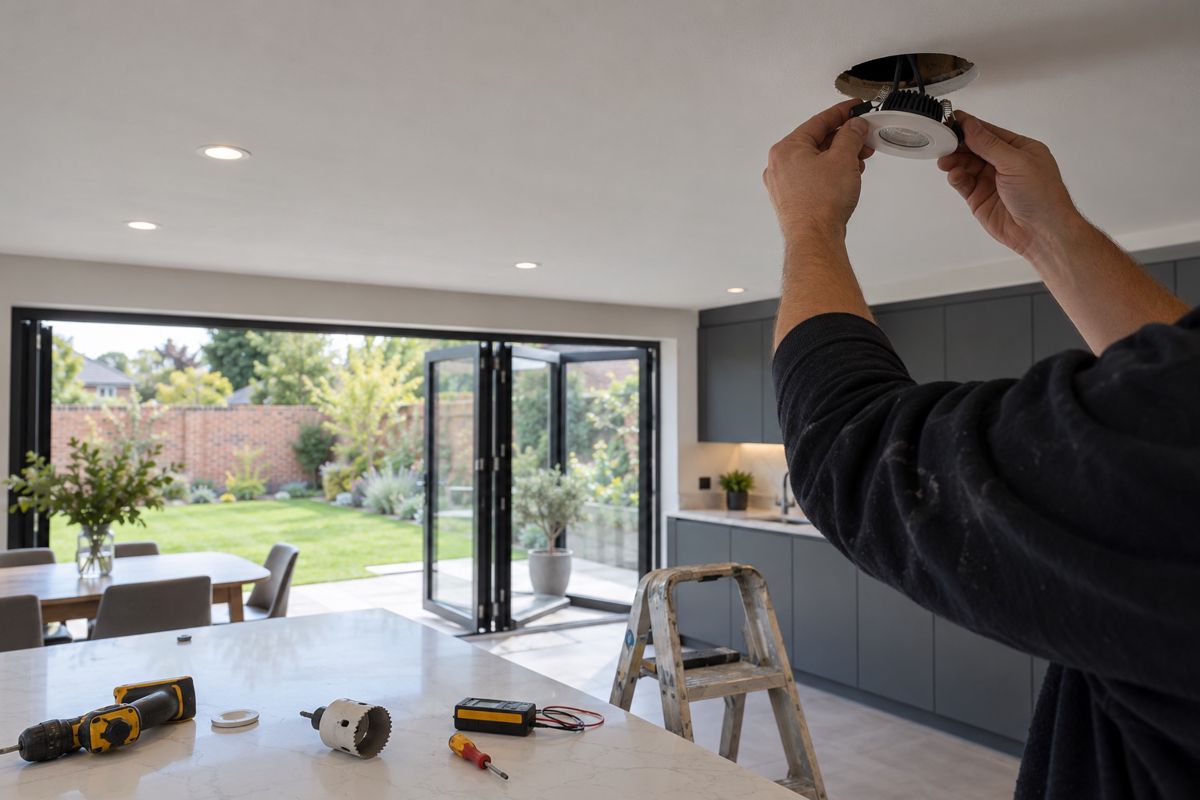
Hands fitting a recessed LED downlight into a kitchen extension ceiling

Indoor and outdoor lighting in Reading

Lighting installation in Reading: downlights, garden lights and fans

New lighting for kitchens, extensions, gardens and hallways across Reading. We check the circuit first and explain the options before you buy.

  • Safe downlight layouts for your ceiling
  • Garden lighting on a protected supply
  • Quotes in writing with fittings listed

Step 1 of 3

What do you need?

What does lighting installation cover?

For lighting installation Reading customers usually ask about three things: recessed downlights, garden or landscape lighting, and ceiling fans. Each one is a different job. Downlights mean cutting holes in a ceiling and wiring a driver for each fitting. Garden lighting needs a protected outdoor supply. Ceiling fans need a secure fixing and the right switch.

The work also includes new switches and dimmers, moving a light to a better place and replacing a tired pendant with something more modern. We start with how you use the room, then match the fittings and positions to it.

How are recessed downlights planned?

Good downlight layouts come from the room, not from a grid. Sketch where you work, read and relax, and place the lights to suit. Too many holes make a ceiling look like a colander and can feel harsh.

Points to check

  • Ceiling depth, because some Victorian terraces have shallow voids and low ceilings.
  • Fire-rated hoods or fittings, so a hole does not weaken the fire protection between floors.
  • Insulation clearances, so heat does not build up in a loft.
  • The IP rating in bathrooms and shower rooms, where water is a risk.
  • Dimmer compatibility, since not every LED will work with every dimmer.

Many Reading terraces with loft conversions have low sloping ceilings, so surface fittings or wall lights may suit better than recessed ones.

What about garden and landscape lighting?

Outdoor lights face rain, frost and the occasional lawnmower. Fittings must be weatherproof, cables must be the right type and buried or protected, and the supply should be on a circuit with RCD protection. Low-voltage lights are common for paths and borders, and mains fittings suit patios, security lights and garden rooms.

Reading gardens are often long and narrow in terrace streets, with side returns and brick walls that work well for wall lights. A supply to a shed or garden office is more involved, and is treated as notifiable work under Part P. If you are planning a new outbuilding, see our EV charger page too, since the same cable route can sometimes be shared. Our home page lists other jobs we cover.

Yes, with care. A fan needs a fixing that can take its weight and movement, a switch or control to suit, and enough height under it. Guidance often looks for around two and a half metres from floor to blade, so rooms with low ceilings are often better with a different solution, such as a wall fan or an extractor.

Bathrooms need extractor fans rather than ceiling fans, with the right IP rating and a route for the duct outside. Some older lighting circuits have no earth conductor, which affects which fittings can be used. If your home has older wiring, a rewire may make sense before adding new fittings.

What changes the price, and what happens on the day?

The main factors are the number of fittings, how easy the ceiling is to reach from above, whether there is a loft or a floor above, and how much plaster and decoration is affected. Extra cable runs, new switches, dimmers and outdoor trenches all add time. The choice of fittings matters too, from basic to designer ranges.

On the day, we mark positions with you, cut holes, run cable, fit the lights and test every circuit. Small jobs can be finished in part of a day, while a whole kitchen or extension takes longer. We list the fittings and what is included in the written quote so there are no surprises.

Before you book, walk round the room in the evening and note where it feels too dark or too bright. Bring a few pictures of fittings you like. That gives us something concrete to price, and makes it easier to agree the number of lights, the switching and the dimmers before any holes are cut.

What you can expect

  1. Written quotes

  2. Local electricians

  3. Fast response

  4. Tidy work

Questions about electrical in Reading

How many downlights do I need in a kitchen?

There is no single right number, because it depends on the size of the room, the ceiling height and the fittings you choose. A common approach is to light work areas well and add softer light elsewhere. We can suggest a layout when we see the room, and you can start with fewer lights and add more.

Do downlights affect loft insulation?

They can. Heat from some fittings should not be trapped under insulation, and holes in a ceiling can let warm air escape. Modern LED downlights run cooler, and fire-rated, insulation-safe versions exist. Tell us if you have a loft above the room, so the right fittings are chosen and the insulation is left in good condition.

Is garden lighting safe in wet weather?

It is when it is installed properly. Outdoor fittings must be rated for water, cables must be the correct type and protected, and the supply should be protected by an RCD. Low-voltage systems reduce risk further. Keep any plug-in garden lighting kits for dry use unless the maker says they are suitable for outdoor mains sockets.

Can ceiling fans go in a low ceiling?

Often not. Fans need clearance below the blades, and most guidance looks for around two and a half metres from the floor. In low terrace ceilings, a wall-mounted fan, a desk fan or better ventilation may be more sensible. We can measure the room and tell you plainly if it will not work.

Will you need to lift floorboards upstairs?

Sometimes, if there is a room above and the cable has to run through the floor void. We try to use existing routes and loft access where we can, and we explain the plan before starting. Any boards lifted are put back, and you are told if a small repair to the finish is likely.

How it works

  1. Call or request a quote

    Tell us what is wrong or what you need.

  2. Clear price

    We explain the work and the cost before starting.

  3. Safe, tidy work

    Done properly, tested and cleaned up.

Request lighting installation

Tell us what you need and we call you back.

No obligation.

Step 1 of 3

What do you need?

Ready when you are. Call now or request a quote online.

Call an electrician